Smart UI – Solutions for Autonomous Logistics from T-Systems Autonomous Logistics / T-Systems

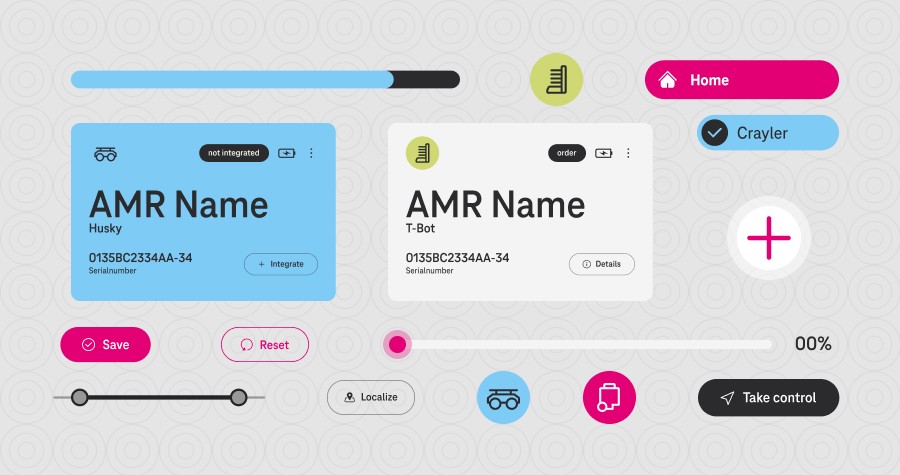
T-Systems' Autonomous Logistics solution transforms logistics processes through the targeted use of innovative technologies. At its core is the digitization of intralogistics using autonomous mobile robots (AMRs) and their seamless control and integration into open logistics platforms. Many analog and digital solutions have emerged from this long-standing research collaboration. These include the logo and visual appearance of the vehicle fleet, as well as well-founded application scenarios and a holistic design system. A study on the control room and the targeted manual operation of the AMR, a concept for teleoperation, and an HMI for fleet management were developed. Complex autonomous processes were prepared in a user-centered manner and visualized transparently and efficiently.
Challenge and Usage
As a research and development project, Autonomous Logistics was characterized by a deliberately open framework from the outset. The product scope, functions, and results were not fully defined at the start of the project, but developed iteratively in the course of the work. This openness had a direct impact on the concept and design and placed special demands on a UX and UI strategy that had to be geared toward change rather than fixed assumptions. At the same time, the system required consideration of very different usage scenarios: from teleoperating workstations to monitoring and management interfaces to the manual control of individual vehicles.
The respective applications differed significantly in terms of information density, interaction logic, and safety-related requirements, but had to be brought together in a consistent overall system. This complexity was further exacerbated by the dynamic development of the project. Requirements and ideas were constantly changing, new technical possibilities—such as the transition from LTE to 5G networks—shifted existing conditions, and the fleets grew steadily with the integration of additional robot types. Against this backdrop, a flexible and scalable design strategy was needed that not only responded to the current situation but could also grow with the system and its requirements.


Teleoperation and Manual Operation of AMRs
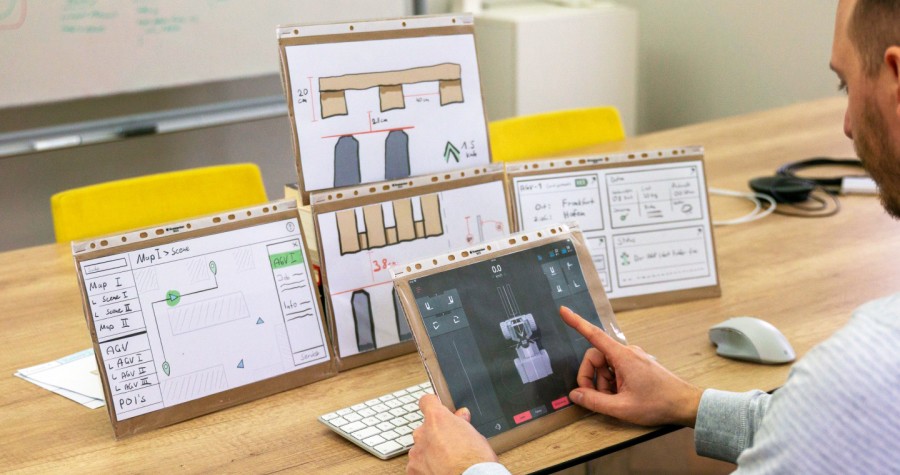
The project developed and tested concepts and prototypes for the teleoperation and manual operation of autonomous mobile robots. A remote control system was created via the campus network, which allowed precise operation of the vehicles from a distance and at the same time enabled realistic usage scenarios. The findings from these tests were directly incorporated into the further development of the operating logic and contributed significantly to improving usability.
Based on this, studies were conducted for a control room designed for semi-autonomous vehicle escorting. The focus was on the interaction between autonomous driving and targeted manual interventions, for example when special situations or safety-critical maneuvers required it. Typical application scenarios included remote-controlled loading and unloading of vehicles, while journeys between defined transfer points were carried out autonomously, resulting in efficient and controllable operations.

Fleet Management via the HMI
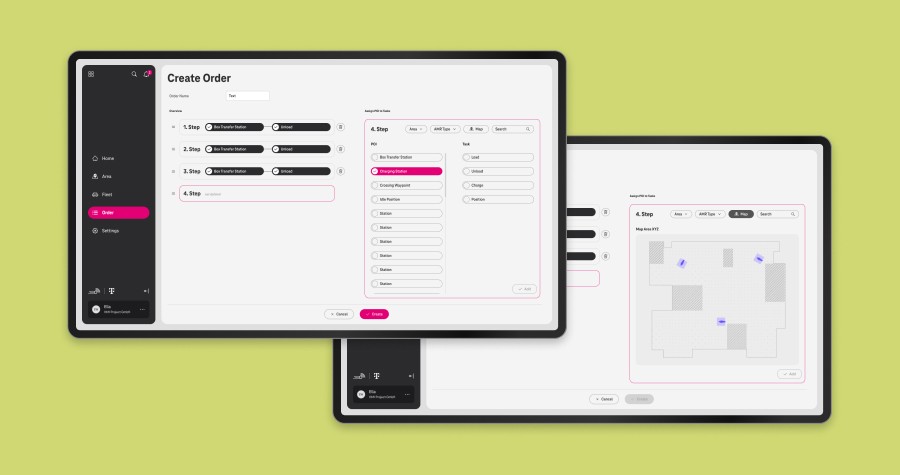
The monitoring, organization, and management of autonomous AMRs are carried out centrally via the HMI, which acts as an integrative interface that brings together all relevant operating, status, and environmental data from the vehicles. Contextual and clear presentation of this information enables efficient coordination of the entire fleet. This not only allows ongoing transports to be tracked, but also enables vehicle conditions to be assessed and potential malfunctions to be detected at an early stage.
The design of the interface is particularly important given the high complexity and dynamics of autonomous logistics systems. A clearly structured information hierarchy, intuitive operating logic, and consistently structured navigation are crucial for users to quickly grasp relevant information, assess situations correctly, and make safe, informed decisions even in critical moments.


Clear Structures for Centralized Management
The HMI brings together all relevant information in a central user interface, creating a shared view of logistics areas, vehicle fleets, routes, and orders. Clearly structured and consistent visualization makes it easy to grasp relationships and navigate the system. Modular views and scalable UI components enable efficient fleet and process management while ensuring that the interface can be flexibly adapted to different application scenarios and existing system landscapes.